s04: Hooks — Hang on the Loop, Don't Write into It

s01 → s02 → s03 → s04s05 → s06 → ... → s20

"Hang on the loop, don't write into it" — Hooks inject extension logic before and after tool execution.

Harness Layer: Hooks — Extension points that don't invade the loop.


The Problem

The s03 Agent has permission checks. But every new check, "log every bash call", "auto git add after writes", requires modifying the agent_loop function.

The loop quickly becomes this:

def agent_loop(messages):
    while True:
        # ... LLM call ...
        for block in response.content:
            if block.type == "tool_use":
                log_to_file(block)          # added a line
                check_permission(block)     # added a line
                notify_slack(block)         # added another line
                output = execute(block)
                auto_git_add(block)         # yet another line
                # ... the loop is unrecognizable

What you want to extend is the Agent's behavior, but what you're modifying is the loop itself. The loop should be a stable core; extensions should hang on the outside.


The Solution
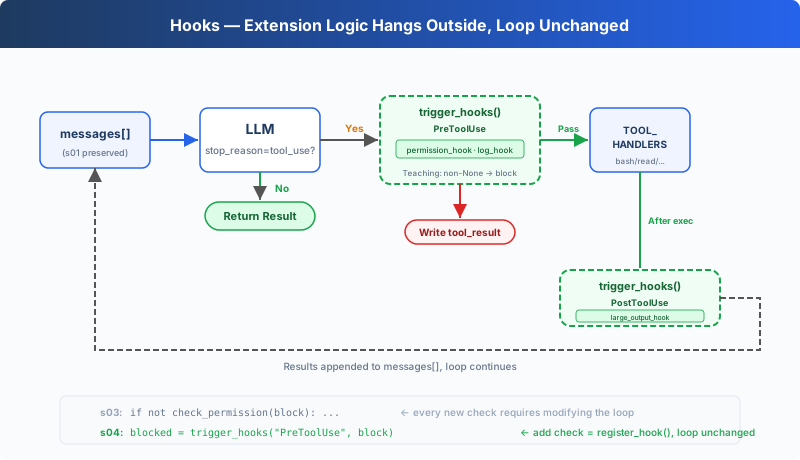
Hooks Overview)

The s03 loop and permission logic are fully preserved. The only change is moving check_permission() from inside the loop body onto a hook. The loop no longer directly calls any check function. Instead it calls trigger_hooks("PreToolUse", block), and the registry decides what to run.

Four events, covering a complete agent cycle:

EventTrigger TimingTypical Use
UserPromptSubmitAfter user input, before entering LLMInput validation, context injection
PreToolUseBefore tool executionPermission checks, logging
PostToolUseAfter tool executionSide effects (auto git add etc.), output checking
StopWhen the loop is about to exitCleanup (CC also supports force continuation)

Extensions are added via register_hook(). The loop only calls trigger_hooks().


How It Works

Hook registry: a dict mapping event names to callback lists.

HOOKS = {
    "UserPromptSubmit": [],
    "PreToolUse": [],
    "PostToolUse": [],
    "Stop": [],
}

def register_hook(event: str, callback):
    HOOKS[event].append(callback)

def trigger_hooks(event: str, *args):
    for callback in HOOKS[event]:
        result = callback(*args)
        if result is not None:   # return value ≠ None → hook says "stop"
            return result
    return None

In the teaching version, PreToolUse returning non-None means block execution; Stop returning non-None means force continuation. UserPromptSubmit and PostToolUse return values are unused.

UserPromptSubmit, triggers after user input, before entering the LLM. CC can intercept or modify input; the teaching version only logs:

def context_inject_hook(query: str) -> str | None:
    """Inject current working directory info into every prompt."""
    print(f"\033[90m[HOOK] UserPromptSubmit: working in {WORKDIR}\033[0m")
    return None   # return None = no modification, let prompt through

register_hook("UserPromptSubmit", context_inject_hook)

In the main loop, triggered right after user input:

query = input("s04 >> ")
trigger_hooks("UserPromptSubmit", query)   # ← before entering LLM
history.append({"role": "user", "content": query})
agent_loop(history)

PreToolUse / PostToolUse, hooks before and after tool execution. s03's permission check logic is now wrapped as a PreToolUse hook, plus a logging hook and a large-output reminder:

# PreToolUse: permission check (s03 logic, moved from loop to hook)
def permission_hook(block):
    if block.name == "bash":
        for pattern in DENY_LIST:
            if pattern in block.input.get("command", ""):
                return "Permission denied by deny list"
    if block.name in ("write_file", "edit_file"):
        path = block.input.get("path", "")
        if not (WORKDIR / path).resolve().is_relative_to(WORKDIR):
            choice = input("   Allow? [y/N] ").strip().lower()
            if choice not in ("y", "yes"):
                return "Permission denied by user"
    return None

# PreToolUse: logging
def log_hook(block):
    print(f"[HOOK] {block.name}(...)")

# PostToolUse: large output reminder
def large_output_hook(block, output):
    if len(str(output)) > 100000:
        print(f"[HOOK] ⚠ Large output from {block.name}")

register_hook("PreToolUse", permission_hook)
register_hook("PreToolUse", log_hook)
register_hook("PostToolUse", large_output_hook)

Stop, triggers when the loop is about to exit (stop_reason != "tool_use"). The teaching version prints a cleanup summary:

def summary_hook(messages: list) -> str | None:
    """Print a summary when the loop is about to stop."""
    tool_count = sum(1 for m in messages
                     for b in (m.get("content") if isinstance(m.get("content"), list) else [])
                     if isinstance(b, dict) and b.get("type") == "tool_result")
    print(f"\033[90m[HOOK] Stop: session used {tool_count} tool calls\033[0m")
    return None   # return None = allow stop, return string = force continuation

register_hook("Stop", summary_hook)

In agent_loop, triggered before exit:

if response.stop_reason != "tool_use":
    force = trigger_hooks("Stop", messages)   # ← before exiting
    if force:
        # hook returned a message → inject it and continue
        messages.append({"role": "user", "content": force})
        continue
    return

Only one change in the loop: s03 directly called check_permission(block), s04 replaces it with trigger_hooks("PreToolUse", block):

for block in response.content:
    if block.type != "tool_use":
        continue

    # s03: if not check_permission(block): ...
    # s04: hooks replace hardcoding
    blocked = trigger_hooks("PreToolUse", block)
    if blocked:
        results.append({"type": "tool_result", "tool_use_id": block.id,
                        "content": str(blocked)})
        continue

    handler = TOOL_HANDLERS.get(block.name)
    output = handler(**block.input) if handler else f"Unknown: {block.name}"

    trigger_hooks("PostToolUse", block, output)

    results.append({"type": "tool_result", "tool_use_id": block.id,
                    "content": output})

Four hooks cover the critical nodes of the agent cycle: input → before execution → after execution → exit. The loop only calls trigger_hooks(); all logic lives in hook callbacks.


Changes from s03

ComponentBefore (s03)After (s04)
Extension methodcheck_permission() hardcoded in the loopHOOKS registry + trigger_hooks()
New functionsregister_hook, trigger_hooks
Hook callbackscontext_inject_hook, permission_hook, log_hook, large_output_hook, summary_hook
LoopDirectly calls check_permission()Calls trigger_hooks("PreToolUse", ...)
Exit controlNonetrigger_hooks("Stop", ...) can prevent exit
Input interceptionNonetrigger_hooks("UserPromptSubmit", ...) can inject context

Try It

cd learn-claude-code
python s04_hooks/code.py

Try these prompts:

  1. Read the file README.md (should pass directly, observe hook logs)
  2. Create a file called test.txt (after creation, observe if PostToolUse fires)
  3. Delete all temporary files in /tmp (bash + rm triggers permission hook)

What to watch for: Before each tool execution, does the [HOOK] log appear? When permission is denied, was it intercepted by a hook or hardcoded in the loop?


What's Next

The Agent can now safely execute operations. But does it ever stop to think "what should I do first, and what next?" Given a complex task, does it jump straight in, or plan first?

→ s05 TodoWrite: Give the Agent a planning tool. Make a list first, then execute.

Dive into CC Source Code

The following is based on a complete analysis of CC source code toolHooks.ts (650 lines), hooks.ts, stopHooks.ts, and coreTypes.ts.

1. Hook Events: Not Just 4, but 27

The teaching version covers only PreToolUse and PostToolUse. CC actually has 27 hook events (coreTypes.ts:25-53):

CategoryEvents
Tool-relatedPreToolUse, PostToolUse, PostToolUseFailure
Session-relatedSessionStart, SessionEnd, Stop, StopFailure, Setup
User interactionUserPromptSubmit, Notification, PermissionRequest, PermissionDenied
Sub-agentsSubagentStart, SubagentStop
Compaction-relatedPreCompact, PostCompact
Team-relatedTeammateIdle, TaskCreated, TaskCompleted
OtherElicitation, ElicitationResult, ConfigChange, WorktreeCreate, WorktreeRemove, InstructionsLoaded, CwdChanged, FileChanged

The teaching version covers only 4 core events (UserPromptSubmit, PreToolUse, PostToolUse, Stop) because they cover every critical node of a complete agent cycle. The other 23 follow the same pattern.

2. HookResult Common Fields

CC's HookResult (types/hooks.ts:260-275) has 14 fields. Common ones:

FieldTypePurpose
messageMessageOptional UI message
blockingErrorHookBlockingErrorBlocking error → injected into conversation for model self-correction
outcomesuccess/blocking/non_blocking_error/cancelledExecution result
preventContinuationbooleanPrevent subsequent execution
stopReasonstringStop reason description
permissionBehaviorallow/deny/ask/passthroughHook returns permission decision
updatedInputRecordModify tool input
additionalContextstringAdditional context
updatedMCPToolOutputunknownMCP tool output modification

3. Key Invariant: Hook 'allow' Cannot Bypass deny/ask Rules

This is the most important security design in CC's permission system (toolHooks.ts:325-331): when a hook returns allow, it still checks settings.json deny/ask rules. Even if the user's hook script says "allow", if the tool is disabled in settings.json, the operation is still blocked.

The teaching version doesn't have this layer; hooks returning non-None directly interrupt. This is sufficient for teaching, but would create a security vulnerability in production.

4. stopHookActive Mechanism

CC's Stop hooks have an infinite-loop prevention mechanism (query.ts:212,1300): the stopHookActive state field. When stop hooks produce a blockingError, the loop re-enters with stopHookActive: true. Subsequent iterations see this flag and don't trigger stop hooks again. This prevents a never-stopping bug: model self-corrects → stop hook errors again → model self-corrects again → stop hook errors again...

5. hook_stopped_continuation

When PostToolUse hooks return preventContinuation: true, a hook_stopped_continuation attachment is produced (toolHooks.ts:117-130). query.ts (L1388-1393) detects it and sets shouldPreventContinuation = true, causing the loop to exit. This is the mechanism for "hooks gracefully shut down the Agent" — not a crash, but a completion.

Teaching Version Simplifications Are Intentional

  • 27 events → 4 (UserPromptSubmit/PreToolUse/PostToolUse/Stop): covers agent cycle critical nodes
  • 14 fields → simple return values (None = continue, non-None = interrupt/continue): minimal cognitive load
  • Hook allow vs deny/ask invariant → omitted: teaching version has no settings.json layer
  • stopHookActive → omitted: teaching version Stop hook only does simple continuation, no infinite-loop prevention needed